Cloud cost optimization: where the money actually leaks
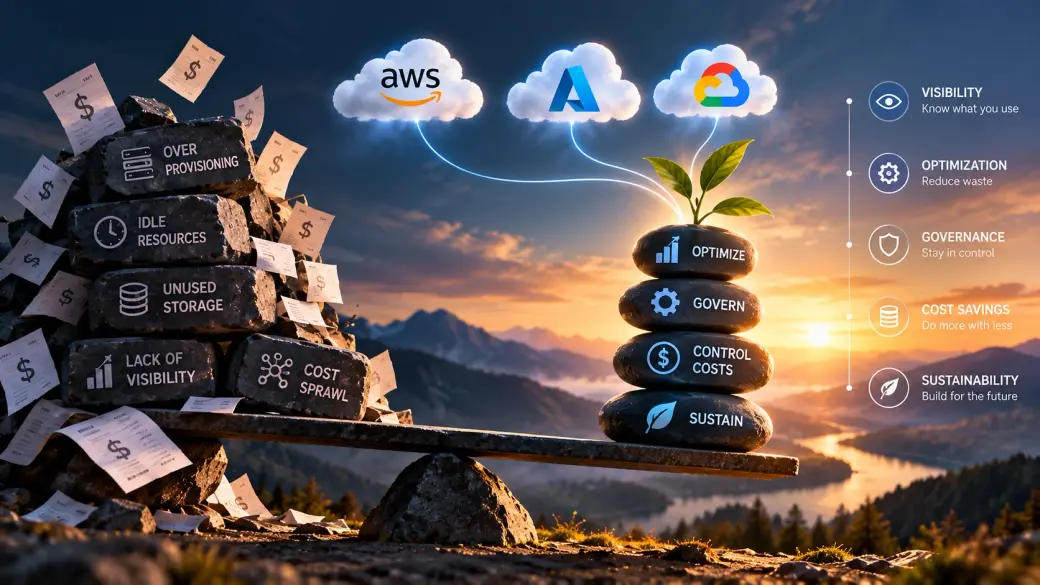
Almost every cloud bill tells the same story if you let it run unwatched: it starts reasonable, grows quietly, and one day someone in finance asks why it doubled — and nobody has a clean answer. The cloud’s great strength, paying only for what you use, is also how costs get away from you. “Pay for what you use” quietly becomes “pay for what you forgot you were using.”
The good news is that cloud waste is one of the most fixable problems in technology. It’s rarely one big leak; it’s a dozen small ones, each easy to plug once you know where to look. Here’s where the money actually goes, and the habits that keep it under control — without turning cost into the thing that slows your team down.
Why the cloud bill grows
Three forces push cloud costs up on their own, unless something pushes back:
- The defaults are generous, not frugal. Cloud consoles make it easy to spin up a bigger instance, a faster disk, or a multi-region setup “to be safe.” Each choice is small; together they’re your bill.
- Nobody owns it. When the cost of a resource is invisible to the person who created it, there’s no feedback loop. Engineers optimise for what they can see — speed, reliability — not for a number that lands on someone else’s desk a month later.
- Nothing gets turned off. On your own hardware, an idle server still cost the same, so leaving it on was free. In the cloud, idle costs real money every hour — and “I’ll clean it up later” rarely happens.
None of this is a failure of the cloud. It’s what happens when a usage-based model meets human nature without a system around it. That system is what people now call FinOps — a plain name for “someone makes cost visible and keeps an eye on it.”
Where the money actually leaks
In practice, the same handful of leaks account for most cloud waste:
- Idle and zombie resources. Instances left running after a project ended, unattached storage volumes, old load balancers, forgotten test environments. They do nothing and bill constantly. A good cleanup almost always finds them.
- Over-provisioning. The single biggest line item for most teams. Instances sized for a peak that never comes, or picked by guesswork and never revisited. Right-sizing to actual usage routinely cuts a workload’s cost by a third or more.
- Paying on-demand for steady workloads. On-demand pricing is for spiky, unpredictable use. Anything that runs reliably month after month should be on a commitment — reserved instances, savings plans, committed-use discounts — which trade a usage promise for a steep discount. Leaving steady workloads on-demand is leaving money on the table every hour.
- Data egress and transfer. Moving data out of a cloud, and sometimes just between regions or zones, costs money — and it’s easy to architect a chatty system that racks up transfer fees nobody noticed until the invoice.
- Storage sprawl. Old snapshots, backups kept forever, logs with no retention policy, and data sitting on fast (expensive) storage tiers when it’s barely touched. Lifecycle rules that move cold data to cheaper tiers or delete it on schedule pay for themselves.
- Non-production running 24/7. Dev, test, and staging environments left on overnight and all weekend. If no one uses them outside business hours, scheduling them to shut down can cut their cost by two-thirds.
- Premium services used out of habit. Reaching for the fully-managed, top-tier version of a service when a simpler, cheaper one would do the job. Managed convenience is worth paying for — but only when you actually need it.
The habits that fix it
Cost control isn’t a one-time cleanup; it’s a few habits that keep the leaks from coming back:
- Make it visible. You can’t manage what you can’t see. Tag resources by team, project, and environment so the bill can be broken down and handed to the people who actually create the cost. Visibility is the single highest-leverage move — most of the other habits follow from it.
- Give the bill an owner. Not “everyone’s responsibility,” which means no one’s. One person or team watches the trend, asks about spikes, and owns the number. This is the whole point of FinOps as a practice.
- Right-size continuously. Review usage and trim over-provisioned resources on a schedule, not just once. Workloads drift; so should their sizing.
- Commit to your baseline. Work out the steady, always-on portion of your usage and cover it with commitments for the discount. Keep on-demand for the spiky top.
- Turn off what’s idle. Schedule non-production to shut down out of hours, and run regular sweeps for zombie resources. Automate it so it isn’t someone’s forgettable chore.
- Set budgets and alerts. A simple alert when spend crosses a threshold turns a month-end surprise into a same-day question. It’s the cheapest insurance in the cloud.
- Architect with cost in mind. Keep data transfer sane, use storage tiers deliberately, and treat a design that’s cheap to run as a feature, not an afterthought.
The part that’s really cultural
The tools matter, but the lasting fix is cultural: cost has to be something engineers can see and feel some ownership of, rather than a bill that lands on finance. The teams that keep their cloud spend sane aren’t the ones with the fanciest tooling — they’re the ones where a developer can see what their service costs and treats that as part of doing the job well. Make the number visible, give it an owner, and most of the waste never accumulates in the first place.
When cheap isn’t the goal
A word of caution, because cost optimization can tip into false economy. The goal isn’t the lowest possible bill — it’s the lowest bill for the reliability and speed you actually need. Stripping redundancy out of a system that genuinely needs it, or making engineers jump through hoops to save trivial amounts, costs more than it saves. Optimise the obvious waste — the idle, the over-provisioned, the un-discounted — and leave the spending that’s buying you something real. A cloud bill you understand beats a cloud bill that’s merely small.
Common questions
How much can cost optimization actually save?
It varies. In Flexera’s 2026 State of the Cloud report — a vendor’s survey — respondents estimated that 29% of their IaaS and PaaS spend is wasted. The waste usually hides in the same places: idle resources, over-provisioning, and missed commitments. The first serious pass usually finds more than people expect, because nobody had been looking.
Do I need a FinOps tool, or is that overkill?
Start with the basics: tagging, the cloud provider’s own cost dashboards, and budget alerts. Dedicated FinOps tooling earns its keep at scale, but the habits — visibility and ownership — matter far more than the software.
Isn't this just the migration "Optimize" phase?
It’s the same idea, made permanent. A migration’s optimize phase is where cost control starts; FinOps is keeping it going for the life of the workload, rather than letting the bill drift back up once the project’s attention moves on.
What's the single highest-leverage habit?
Visibility. Tag your resources and show each team what it’s spending. Almost everything else — right-sizing, killing idle, committing to the baseline — follows naturally once the cost stops being invisible.