Insta360 Luna Ultra Explained: The Leica Pocket Camera, and Who It's Really For
Think about the last moment you tried to film and wished you hadn’t bothered. The video shook every time you took a step. You zoomed in and the picture turned to mush. Or you were so busy holding the phone that you watched the whole thing through a screen instead of living it.
For years, one type of gadget has quietly fixed most of those problems: the pocket gimbal camera. It’s a small camera that sits on a tiny motorised stand, and those motors cancel out the shake from your hands. Walk, run, turn around, and the picture stays smooth, as if someone had laid down rails for a film crew.
DJI owned this category almost by itself. In June 2026, that changed. Insta360, the company best known for 360-degree cameras, launched the Luna Ultra, built together with the legendary German camera maker Leica. It is the first serious rival the category has had at the high end, and it brings a few ideas no pocket camera had before.
This guide explains what the Luna Ultra is, what it does well, who it suits, and who should probably buy something else.
What the Luna Ultra actually is
Picture a camera about the size of a candy bar. On top sits a small head holding two lenses. That head is mounted on three tiny motors, one for each direction it can tilt or turn, which is what “3-axis gimbal” means. Below it is a handle with the controls and a screen.
It weighs about 233 grams (Insta360’s figure), roughly the same as a modern smartphone, so it fits in a jacket pocket or a small bag.
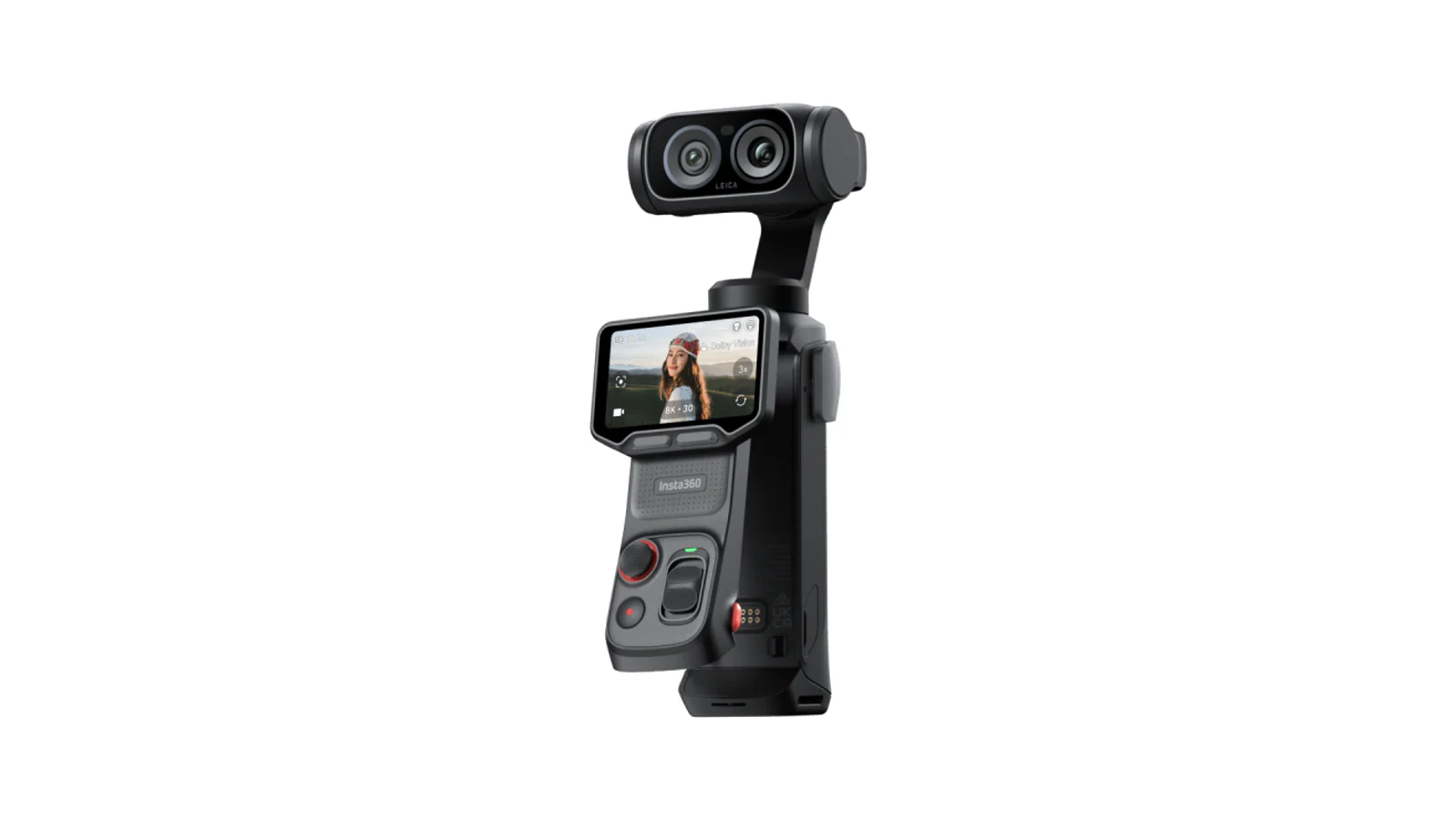 Image: Insta360
The headline numbers, without the jargon:
- Two cameras in one. A wide main camera with a large 1-inch sensor, plus a second zoom camera.
- Up to 8K video at 30 frames per second, or 4K at up to 120 frames per second for smooth slow motion.
- Leica lenses and colour styles, with looks called Leica Natural, Leica Vivid and Leica Chrome built in.
- A screen that comes off and works as a wireless remote.
- Price: $769.99 at launch. Prices vary by country.
The three things that make it different
1. Two lenses, so zoom finally works
Zoom has always been the weak spot of small cameras. Most of them “zoom” by cropping into the picture, which is really just enlarging it, and the quality falls apart quickly.
The Luna Ultra solves this the way good smartphones do: with a second, dedicated lens. The main lens is wide (similar to a 20mm lens on a professional camera), which is ideal for scenery and for filming yourself at arm’s length. The second lens is a telephoto (similar to 60mm), which brings distant subjects closer and gives faces a natural, flattering look with a softly blurred background.
Between them, you get 3x true optical zoom, 6x zoom with very little visible loss, and up to 15x digital zoom when you really need to reach (12x at launch; a September 2026 software update raised it). Reviewers also found the zoom lens is handy for close-up “macro” shots of small things, like food, flowers or product details.
2. A screen that detaches and becomes a remote
This is the feature people talk about most. The front panel, which holds a 2-inch touchscreen and the main controls, simply pops off. Once removed, it keeps working as a live wireless monitor and remote control from up to about 20 metres away.
Why does that matter? Because the hardest shot for anyone filming alone is the one they are in. Set the camera on a table, a wall or a small tripod, walk into the scene, and check your framing on the little screen in your hand. You can start and stop recording without running back to the camera. For solo travellers, small business owners and anyone recording themselves, this removes one of the most annoying parts of filming.
3. Picture quality that punches above its size
A bigger sensor collects more light, and more light means cleaner, richer pictures, especially indoors and at night. The Luna Ultra’s 1-inch main sensor is large for a camera this small, and Insta360 pairs it with what it calls a “Triple AI Chip”, which it says cleans up footage in real time when light is low.
For people who edit their videos, it also records in 10-bit colour, Dolby Vision HDR, and a flat “log” profile (I-Log) that keeps more detail for colour grading later. If none of that means anything to you, that’s fine: the built-in Leica colour styles give footage a finished, cinematic look straight out of the camera.
It takes photos too: 37-megapixel stills and 200-megapixel panoramas.
Real-life uses: who gets the most out of it
The traveller
Travel is where a pocket gimbal earns its price. Walking through a market, riding a boat, climbing old stone steps: the motors keep everything smooth without a bag full of gear. The wide lens takes in the whole view, and the zoom lens picks out a detail across the square or a building on the horizon. Strong low-light performance helps with sunsets, night streets and dim interiors.
The parent at the back of the hall

Every parent knows this one. The school play starts, you’re stuck in the back row, the lighting is dim, and your phone footage is a blur of tiny figures. A dedicated telephoto lens plus a large sensor is exactly the combination that solves it: you get closer to your child’s face, with steadier, cleaner footage in poor light. The camera’s subject tracking (Insta360 calls it Deep Track) can also keep a chosen person in frame as they move around the stage.
The small business owner

Short product videos sell, but hiring a videographer is expensive. A baker, a candle maker or a boutique owner can film smooth product shots, quick behind-the-scenes clips and close-ups of textures and details, then post them the same day. The Insta360 app can pick out highlights and suggest ready-to-share edits, which saves time for people who aren’t professional editors.
The solo creator

For anyone who films themselves, whether it’s a vlog, a course, a podcast clip or a tutorial, the detachable screen is the star. Place the camera, step back, check the framing in your hand, and record. Four built-in microphones and a wind guard handle casual audio, and Insta360’s own wireless mics pair directly when you want clearer voice. Built-in timecode also makes it easier to edit the footage in professional software such as Final Cut Pro or Adobe Premiere Pro.
How it compares to the DJI Osmo Pocket 4P
The obvious alternative is DJI’s Osmo Pocket 4P, which went on sale in China five days after the Luna Ultra (and worldwide on 30 July 2026) and also has two lenses. Both are excellent. They simply lean in different directions.
| Insta360 Luna Ultra | DJI Osmo Pocket 4P | |
|---|---|---|
| Launch price | $769.99 (US); £649 (UK) | £529 / €599 (Standard Combo); not sold in the US |
| Highest video resolution | 8K at 30fps | 4K |
| Smoothest 4K slow motion | 120fps | 240fps (wide camera) |
| Detachable screen remote | Yes, included | No |
| Size | Slightly larger | Slightly more compact |
| Built-in storage | 47GB (plus microSD up to 2TB) | 103GB |
| Software and accessories | Newer, improving quickly | More mature ecosystem |
Choose the Luna Ultra if you want the highest resolution, the Leica look, and the freedom of a detachable remote screen, especially if you often film yourself.
Choose the DJI Pocket 4P if you want the more compact body, stronger slow motion, a longer-proven app and accessory range, or a lower price where it’s sold.
One practical note: availability differs by region. The Pocket 4P isn’t officially sold in the United States, which makes the Luna Ultra the easier choice there. Check what’s sold where you live before deciding.
Who it’s not for
No camera suits everyone, and the Luna Ultra is no exception. It may not be the right pick if:
- You want the smallest camera possible. It’s a little bigger and slightly heavier than DJI’s pocket cameras. It still fits a pocket, just not as easily.
- You already own another brand’s wireless microphones. Over Bluetooth, it currently pairs only with Insta360’s own mics. Other brands can still connect through a USB receiver, but it’s an extra step.
- Slow motion is your main style. It records 4K at up to 120fps, while the DJI Pocket 4P reaches 240fps in 4K on its wide camera.
- You expect perfectly polished software on day one. This is Insta360’s first gimbal camera, and a few features are still arriving. The upside: the company has been shipping meaningful updates quickly since launch.
- You only film occasional short clips. If your phone already handles your needs, the Luna Ultra is a premium upgrade rather than a necessity.
Price and availability
The Luna Ultra launched on 10 June 2026 at $769.99, in two colours, Cosmic Black and Stellar White. It is sold through the official Insta360 store and major retailers worldwide, with prices varying by country and some markets getting it later.
Bundles with extra accessories are available, along with add-ons such as an ND filter set (for bright, sunny conditions) and Insta360’s wireless microphones. Insta360 also sells a simpler, single-lens sibling called the Luna Pro for people who don’t need the zoom camera.
The bottom line
The Luna Ultra is a confident first step into a category that one company had to itself for years. Two lenses make zoom genuinely useful, the detachable screen solves the oldest problem of filming alone, and the Leica partnership shows in the colours.
It isn’t the smallest or cheapest option, and its software is still catching up to a more established rival. But for travellers, parents, small business owners and creators who want noticeably better video than a phone can deliver, in something that still slips into a pocket, it’s one of the most capable choices available right now.
Specifications and prices are based on Insta360’s launch information and published reviews as of October 2026, and may change with software updates or by region.
Common questions
Is the Insta360 Luna Ultra better than the DJI Osmo Pocket 4P?
Neither is simply “better.” The Luna Ultra offers 8K video, a detachable screen remote and Leica colour styles. The DJI Pocket 4P is slightly smaller, cheaper where it’s sold and stronger at slow motion, with a more mature app and accessory range. Pick based on which of those matters most to you.
Is the Luna Ultra good for beginners?
Yes. You can point it and press record, and the gimbal handles the smoothness for you. The Leica colour styles and app-based auto edits help beginners get good-looking results without learning editing software. The advanced settings are there when you’re ready for them.
Does the Luna Ultra need a phone to work?
No. It records on its own using the built-in screen and controls. The Insta360 app on your phone is useful for transferring footage, editing and updating the camera’s software.
Can it shoot vertical video for social media?
Yes. A portrait setting records vertical video for short-form platforms, at up to 4K and 30fps since a September 2026 software update, and the detachable screen supports both portrait and landscape framing.
How long does the battery last?
Insta360 rates it for up to about four hours, depending on settings. Higher resolutions and frame rates use more power. It also fast-charges, reaching 80% in around 23 minutes with a compatible charger.
What's the difference between the Luna Ultra and the Luna Pro?
The Luna Ultra has two cameras, a wide main lens and a zoom lens. The Luna Pro is the more affordable single-lens version, for people who mostly shoot wide and don’t need optical zoom.
Sources
- Insta360, "Insta360 Launches Luna Ultra: Leica Co-Engineered Gimbal Camera Built for Next-Generation Mobile Filmmaking" (press release, 10 June 2026) en.prnasia.com
- Insta360, Luna Series hardware specifications (Luna Ultra) onlinemanual.insta360.com
- Insta360 UK store, Luna series prices store.insta360.com
- Newsshooter, Insta360 Luna Ultra firmware 1.1.8 (21 September 2026) newsshooter.com
- DJI, Osmo Pocket 4P specs dji.com
- RedShark News, DJI Osmo Pocket 4P global launch pricing redsharknews.com
- DroneXL, DJI Osmo Pocket 4P launch dates and US availability (23 July 2026) dronexl.co