Microduck: The Complete Guide to Hugging Face's $399 Robot Duck
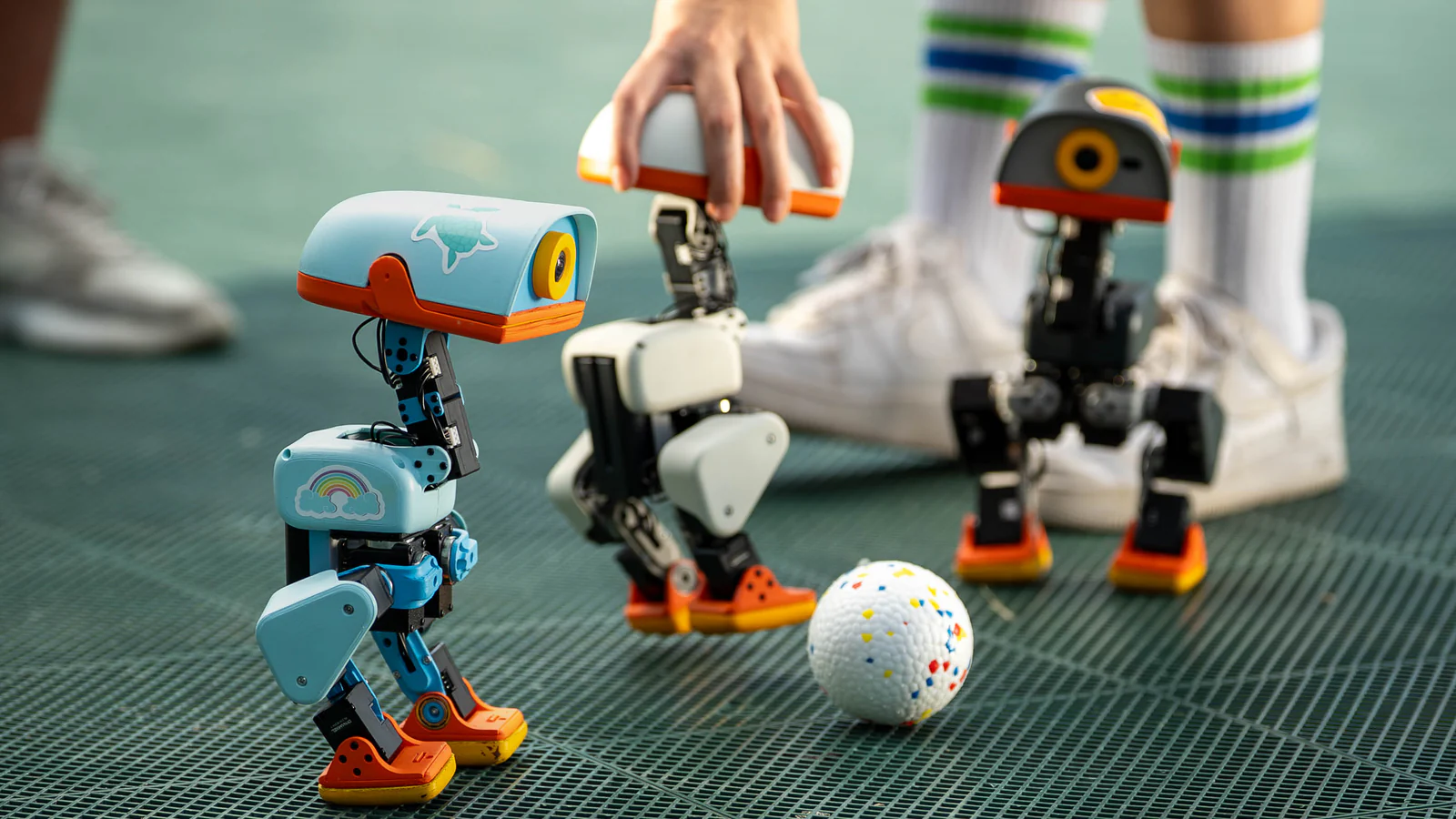
On August 27, 2026, Hugging Face and its robotics team, Pollen Robotics, put a $399 robot duck up for preorder — and within about a day, demand pushed orders past $2.6 million. The thing is called Microduck, it is 25 centimeters tall, it waddles, it picks socks up off the floor with its beak, it falls over and gets back up, and it can even roller-skate. It is also, underneath the cuteness, one of the more interesting bets in consumer robotics right now.
Microduck is not trying to be a home butler. It is a small, open, affordable platform for teaching a robot to move — and the pitch is not the tricks it does out of the box, but that you can train it to do new ones yourself using reinforcement learning, the same broad technique behind a lot of modern AI. The entire training stack is public. You can even try its trained behaviors in a browser simulator before a physical duck ever arrives.
This guide covers all of it: what Microduck is and who built it, every spec that matters, how the training actually works, the important catch about what “open source” does and does not mean here, what it costs and when it ships, how it stacks up against other small robots, who it is genuinely for, and the bigger story about affordable physical AI that it sits inside. If you have been duck-curious since the launch, this is the full picture as of late October 2026.
Based on the maker’s published information and independent reviews, not a hands-on test.
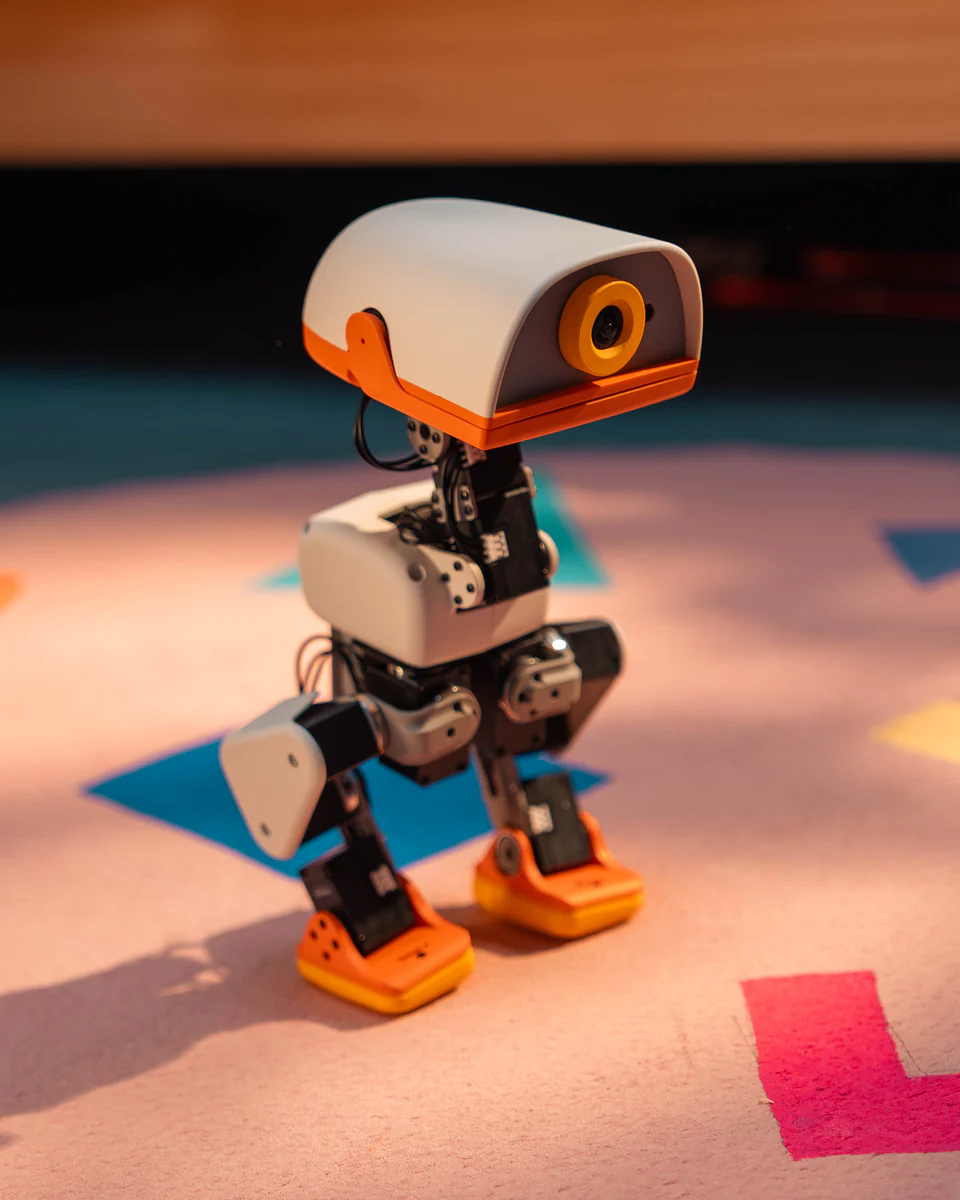 The Microduck in the Cream colourway. Photo: Pollen Robotics / Hugging Face.
What Microduck actually is
Microduck is an open-source bipedal robot — a two-legged walking machine — shaped like a duck, made by Pollen Robotics, the Bordeaux-based robotics team that Hugging Face acquired in April 2025. Pollen was founded in 2016 by former Inria researchers, so the duck is the work of people who have been building open robots for the better part of a decade, not a novelty side project. Hugging Face is the open-source AI platform best known as the place developers host and share machine-learning models; buying a robotics company was its move from software into physical hardware. Microduck is the second robot from that partnership.
The duck framing is not just marketing, though it helps. Pollen says the shape genuinely fit the engineering: the proportions, the beak, and the waddling two-legged gait all map naturally onto a duck. It comes in four soft colorways — Cream, Graphite, Lavender, and Sky — and the company notes that a group of them standing together reads as “a collection of different characters rather than identical machines.” There is a practical upside to the cuteness, too. A biped that is learning to walk falls over constantly, and a duck falling over and waddling back up looks endearing rather than broken. As Hugging Face CEO Clem Delangue told Axios, the team designed it to be “made to move, ready to fall.”
Out of the box, Microduck can walk, crouch, sit, pick small objects up with an articulated beak that works as a gripper, recover its balance when pushed, get back on its feet after a fall, and, with the rollers from the $39 Accessory pack, roller-skate. Unlike the team’s previous robot, it does not speak in words. It communicates through sound — it has a microphone and a speaker — and each unit is given its own permanent “audio identity” the first time it wakes up, so your duck chirps differently from someone else’s.
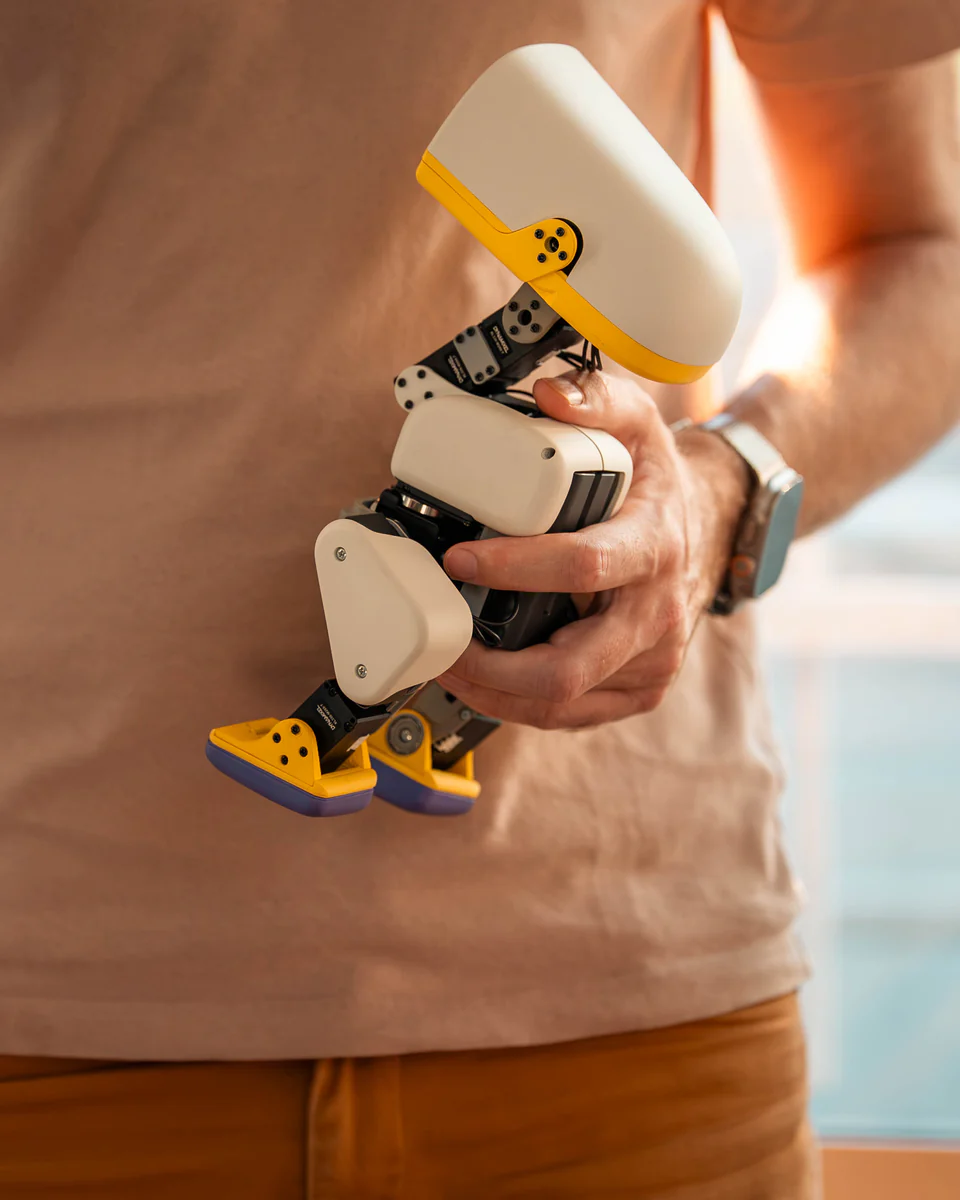 At 25 cm and under 800 g, Microduck is carried in one hand. Photo: Pollen Robotics / Hugging Face.
The specs, without the marketing
Microduck is small and sensor-dense for the price. Here is what is actually inside it.
| Spec | Microduck |
|---|---|
| Height | 25 cm (about 10 inches) |
| Width | 14 cm |
| Weight | Under 800 g (about 1.76 lb) |
| Motors | 15 degrees of freedom across articulated legs, head, and neck |
| Manipulation | Articulated grasping beak that opens and closes to grab objects |
| Compute | Rockchip RK3566 with an AI accelerator |
| Memory | 1 GB RAM, 32 GB storage |
| Control loop | 50 Hz onboard policy loop |
| Vision | Front camera, with a dedicated camera-use indicator inspired by classic REC lights |
| Range sensing | Compact LiDAR — an 8×8 time-of-flight matrix |
| Motion sensing | 2 IMUs, one in the body and one in the head |
| Audio | Microphones and speaker, with a per-robot generated voice |
| NFC | 2 antennas, one in the head and one in the beak |
| Connectivity | Wi-Fi and Bluetooth |
| Battery | Removable NP-F550 camera battery, 2600 mAh, around one hour of runtime |
| Trained moves | 7 trained moves in the box, plus a game controller playable before writing any code |
| Software | Open-source SDK: virtual training environments, RL training tools, tested sim-to-real workflow |
| Colourways | Cream, Graphite, Lavender, Sky |
| Price | $399 (introductory, before tax and shipping) |
A few things are worth reading between the lines of. The one-hour battery and the roughly 100-gram lifting limit tell you plainly that this is a research and hobby platform, not a worker — it is built for short, repeated training and play sessions, not continuous duty — though the battery is a standard removable NP-F550 camera cell, so a spare swaps in seconds. The 8×8 time-of-flight LiDAR is a modest sensor — a coarse depth grid, not a mapping-grade scanner — but paired with the dual IMUs it is enough to learn real balance and simple spatial awareness. And the beak-as-gripper is the clever bit of industrial design: rather than bolt on arms, Pollen made the duck’s defining feature do double duty, which keeps the robot light and cheap while still letting it manipulate the world.
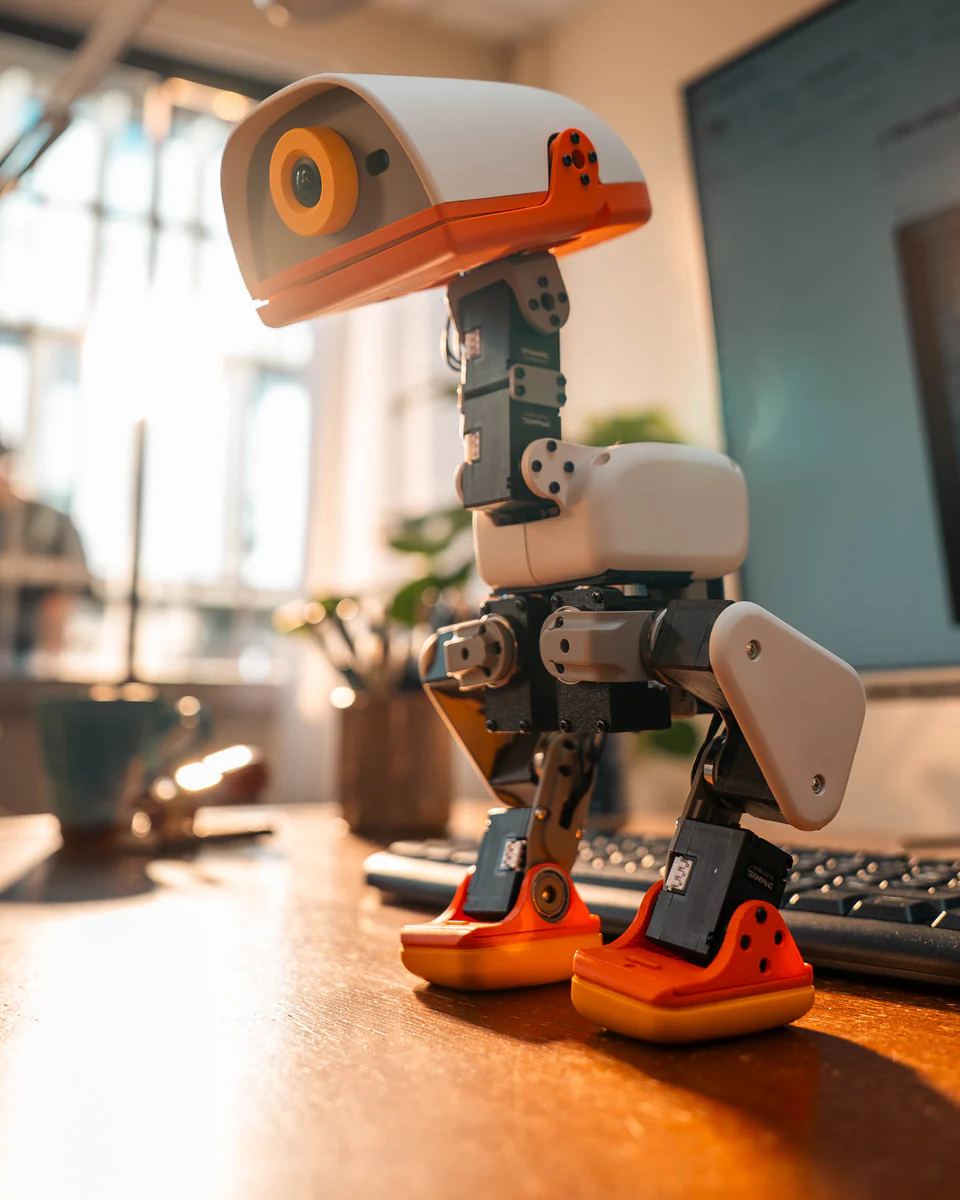 The front camera sits in the head; the orange beak doubles as a gripper. Photo: Pollen Robotics / Hugging Face.
How you train it: reinforcement learning, explained plainly
This is the part that makes Microduck more than a toy. Every movement it makes — walking, crouching, kicking, roller-skating, standing back up — is not hand-coded. It is a behavior learned through reinforcement learning (RL): the robot tries a movement, fails, adjusts, and tries again, thousands of times, keeping what earns a reward and discarding what does not, until it converges on something that works. It is learning by trial and error, at machine speed.
The catch with trial and error on a physical robot is that a real duck falling 10,000 times would destroy itself. So the training happens somewhere safe first: a physics simulator. Here is the loop in four steps.
- Simulate. A virtual Microduck lives inside a physics engine — Pollen uses MuJoCo (specifically mjlab / MuJoCo Warp), a standard tool for this. You can run thousands of virtual ducks in parallel; the training reportedly uses around 4,096 environments at once.
- Train a policy. An RL algorithm (PPO, a widely used method) rewards the virtual duck for getting closer to the goal — staying upright, moving forward — and over roughly one to two hours it learns a “policy,” which is just the neural network that decides what each motor should do moment to moment.
- Cross the sim-to-real gap. Simulations are never exactly like reality, so the policy is trained against deliberately randomized conditions — varying friction, command delay, voltage, and about a degree of mechanical slack — so it does not shatter the instant it meets the messier real world. This is called domain randomization, and it is what makes sim-to-real transfer actually work.
- Deploy to the robot. The trained policy is exported (via ONNX, a portable model format) and runs on the physical duck. You can then fine-tune it, retrain, and redeploy.
The genuinely approachable part: there is a Microduck simulator hosted on Hugging Face that runs in your browser, no hardware required. You can drive the virtual duck through its trained behaviors before committing $399; training your own needs an Nvidia (CUDA) graphics card or paid time on Hugging Face Jobs. And the full stack — the SDK, the robot control software, the MuJoCo training environments, the reward functions, and the sim-to-real recipe — is public on GitHub in the pollen-robotics/microduck and pollen-robotics/microduck_rl repositories. As MarkTechPost put it, most robotics launches ask you to trust a demo video; this one ships the training loop itself.
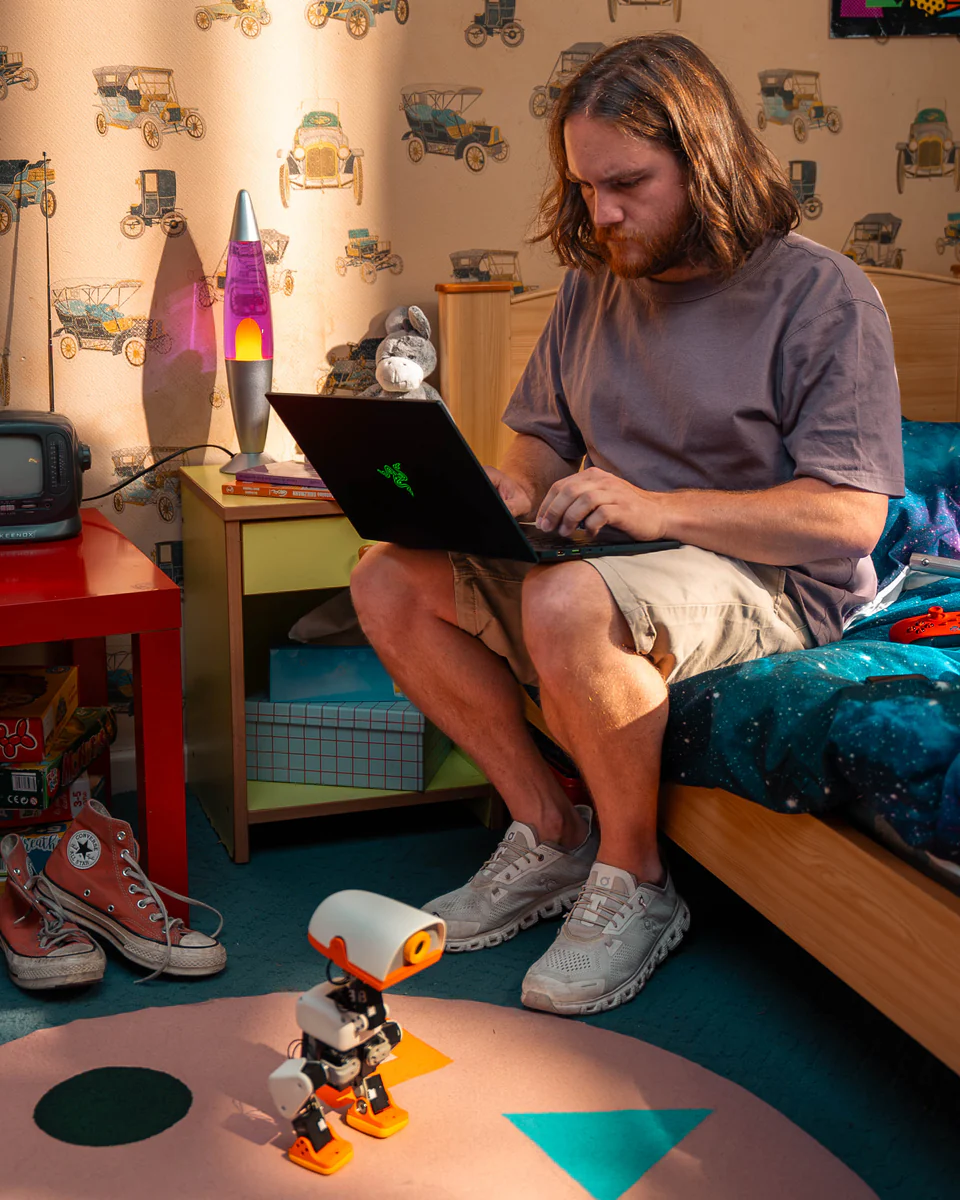 Train a behavior in simulation, then run it on the robot at home. Photo: Pollen Robotics / Hugging Face.
“Open source”: what it does and doesn’t mean here
This is the detail most casual coverage glosses over, and it matters if you are deciding whether to buy. Microduck’s software is open source — genuinely, under the permissive Apache 2.0 license, available on GitHub today. The SDK, the robot control code, the simulation, and the full RL training stack are all public and auditable.
The hardware is not. Pollen Robotics has been explicit about this: the mechanical and electronic design files are not open, and the company asked journalists not to describe Microduck as “open-source hardware.” A Pollen representative told The Register it has no plans to open-source the hardware. So what you are buying is an open software stack running on a closed physical body — unlike Pollen’s earlier Reachy Mini, which was announced as open hardware.
Why does this distinction matter in practice? On the upside, open software means you can inspect exactly how the robot behaves, modify it, train entirely new skills, and share them with others — real control and auditability. On the downside, you cannot manufacture your own Microduck, fully repair or rebuild the hardware from published plans, or fork the physical design the way you could with a truly open-hardware project. It also does not, by itself, guarantee anything about data privacy once software is installed. For most buyers — developers and tinkerers who want to train behaviors, not fabricate ducks — the open software is the part that counts. But “open source” here is a precise claim about the code, not a blanket one about the robot.
Price, preorder, and when it ships
Microduck costs $399, before tax and shipping — and Pollen frames that as an introductory price, so it may rise. Preorders opened on August 27, 2026 through the Pollen Robotics site, with first deliveries targeted before Christmas 2026 (Pollen now quotes 4–6 months for new orders) and availability at launch across North America, Europe, and the UK.
The base price buys the robot, a battery, a USB-C cable, and a game controller. Three add-on packs round out the range:
| Pack | Price | What’s in it |
|---|---|---|
| Microduck (base) | $399 | Robot, battery, USB-C cable, game controller |
| Charger pack | $39 | Dual charger, 2 batteries |
| Dev pack | $119 | 3 spare motors, 5 motor cables, 2 batteries, dual charger, 10 NFC tags, Hugging Face credit, screwdriver and screw pack |
| Accessory pack | $39 | Laser pointer, NFC polaroid, 2 rollers, ball, 10 NFC tags |
The Dev pack is the telling one: spare motors, cables, and a screwdriver signal that Pollen expects owners to open the robot up, break things, and repair them — exactly what a trial-and-error training platform needs.
The demand was the story of launch week. Pollen’s previous robot, Reachy Mini, had sold more than 10,000 units, and Delangue publicly said he expected Microduck to beat the roughly 20,000-unit record of today’s best-selling robots. The preorders moved fast enough to make that look plausible: Hugging Face co-founder Thomas Wolf said orders passed $2.6 million in the first 24 hours, and told Bloomberg it was selling one every four seconds early on. Treat the exact figures as approximate launch-week numbers rather than audited totals, but the direction is not in doubt: it sold hard and fast.
If you want to try before you buy, you do not have to wait for hardware or a preorder slot. The browser-based Microduck simulator on Hugging Face lets you try the trained behaviors at no cost, and the full software stack is already on GitHub. For a lot of prospective buyers, that is the smart first move — run the loop in simulation, decide whether the workflow appeals to you, and then order the physical duck.
Microduck vs Reachy Mini vs the competition
The cleanest way to understand Microduck is against Pollen’s own previous robot. Reachy Mini is AI that interacts — a desktop companion that stays put, sees and hears you, and talks. Microduck is AI that acts — it leaves the desk, moves through the world, falls, and gets back up, and it communicates in chirps rather than words. Same team, opposite premise. Pollen is clear they are different products, not an upgrade path — in its own words, “Microduck is not Reachy Mini with legs.” It is built for motion instead of conversation.
Against the wider market, Microduck occupies an unusual corner: cheap and walking. Most affordable small robots are stationary or are quadrupeds (four legs, which are far easier to balance than two); the genuinely capable bipeds and quadrupeds cost many times more.
| Robot | Maker | Price | Type | Trains via RL |
|---|---|---|---|---|
| Microduck | Pollen Robotics / Hugging Face | $399 | Walking biped | Yes, open stack |
| Reachy Mini | Pollen Robotics / Hugging Face | $399–$499 | Desktop, stationary | Limited |
| Petoi Bittle | Petoi | ~$300 | Quadruped | Community projects |
| Unitree Go2 | Unitree | ~$1,600+ | Quadruped | Yes |
| Unitree G1 | Unitree | ~$13,500+ | Humanoid | Yes |
| Disney BDX droid | Disney | Not for sale | Walking biped | Yes, Disney in-house |
What the table makes obvious is why Microduck drew attention out of proportion to its size. A two-legged robot that walks, manipulates objects, and ships its entire RL training pipeline, for under $400, simply did not exist before as a ready-made product. The closest thing in spirit — Disney’s charming BDX droids, which Microduck’s falling-and-recovering gait visibly echoes — is a research showpiece you cannot buy. Microduck’s bet is that putting that capability in reach of hobbyists and students, at a price a single developer can justify, is worth more than another expensive lab platform.
Pollen says a group of Microducks is “about ten times more fun” — they even play soccer. Photo: Pollen Robotics / Hugging Face.
Who Microduck is actually for
It helps to be honest about what this duck is and is not, because the cuteness invites unrealistic expectations.
It is a strong fit if you are:
- An AI or robotics developer who wants real hardware to run reinforcement-learning experiments on, without a five-figure lab budget.
- A student or educator teaching robotics, RL, or sim-to-real — the browser simulator and open stack make it a genuine learning tool, not just a demo.
- A serious hobbyist or maker who wants to train and share custom behaviors and tinker with a mobile platform.
- Someone who wants a tangible, approachable way into “physical AI” and is happy to learn the workflow.
It is the wrong tool if you want:
- A household helper. The roughly one-hour battery and ~100-gram lifting limit (Pollen’s own estimate) rule out chores or continuous tasks. Pollen itself has been upfront that Microduck will not solve robotics’ hardest problems, and it does not need to.
- A plug-and-play toy that needs no learning. It does ship with 7 trained moves and a game controller you can use before writing any code, so it does something fun immediately, but the whole point is the training, and getting value from that means engaging with the tools.
- Open hardware you can manufacture or deeply modify physically. As covered above, the chassis is closed.
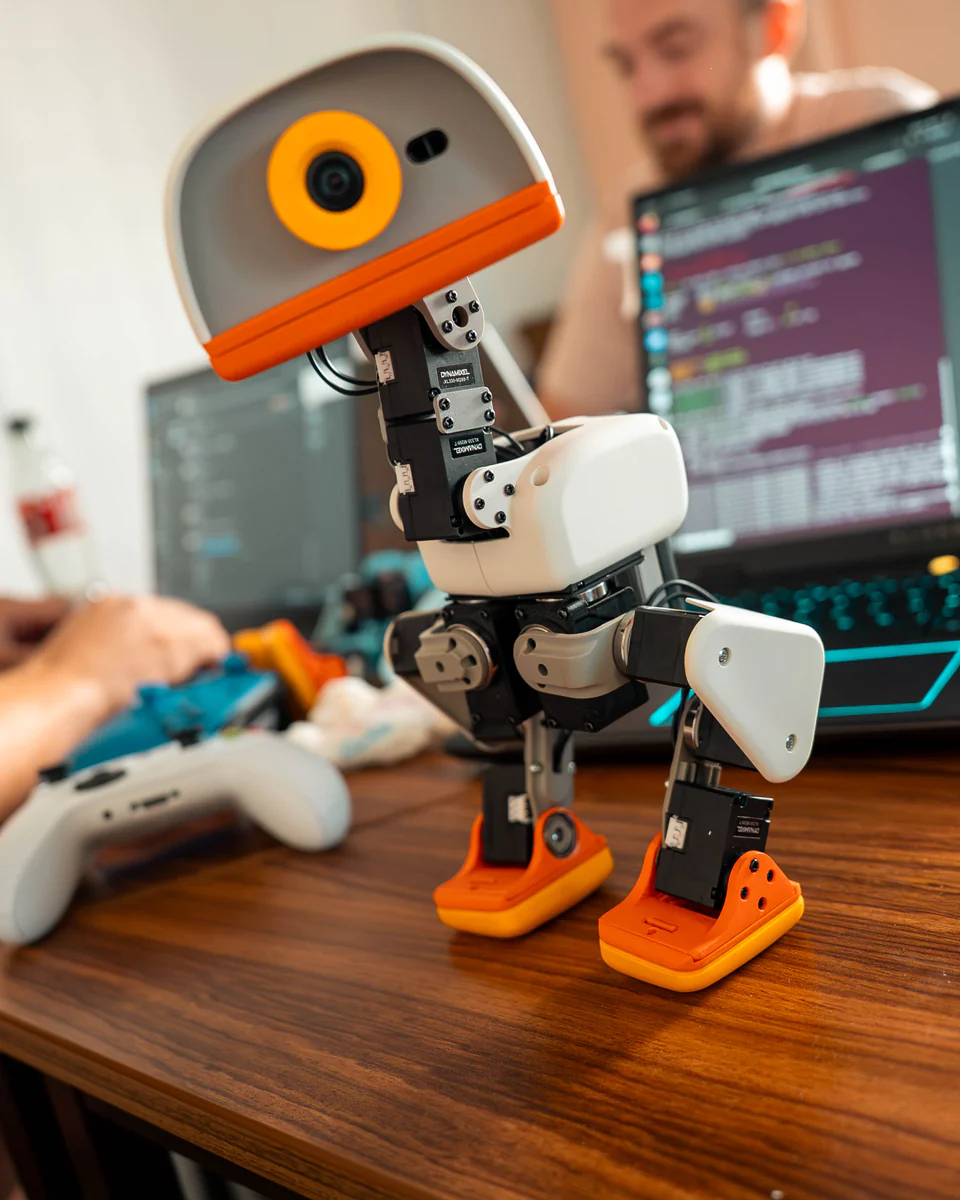 Microduck is built for developers, students, and makers who want to teach a robot to move. Photo: Pollen Robotics / Hugging Face.
The fair summary: Microduck is a research and hobby platform wearing a delightful costume. If the idea of teaching a robot to walk — and watching it fail and improve — sounds like your kind of afternoon, it is close to unmatched at the price. If you wanted a robot that does useful work out of the box, this is not that, and no small robot at this price is.
The bigger picture: why a duck, why now
Microduck arrived at a moment when the industry’s attention had narrowed to two kinds of robot: menacing-looking quadruped “attack dogs” and expensive humanoids. Hugging Face’s pitch is a deliberate counter-move — put a friendly, affordable, approachable face on robotics and get the hardware into as many developers’ hands as possible. Delangue has spent the past year arguing that open models beat closed ones in AI, and he frames Microduck as the same thesis applied to the physical world: “Welcome to the era of open-source affordable robots to democratize physical AI and world models.”
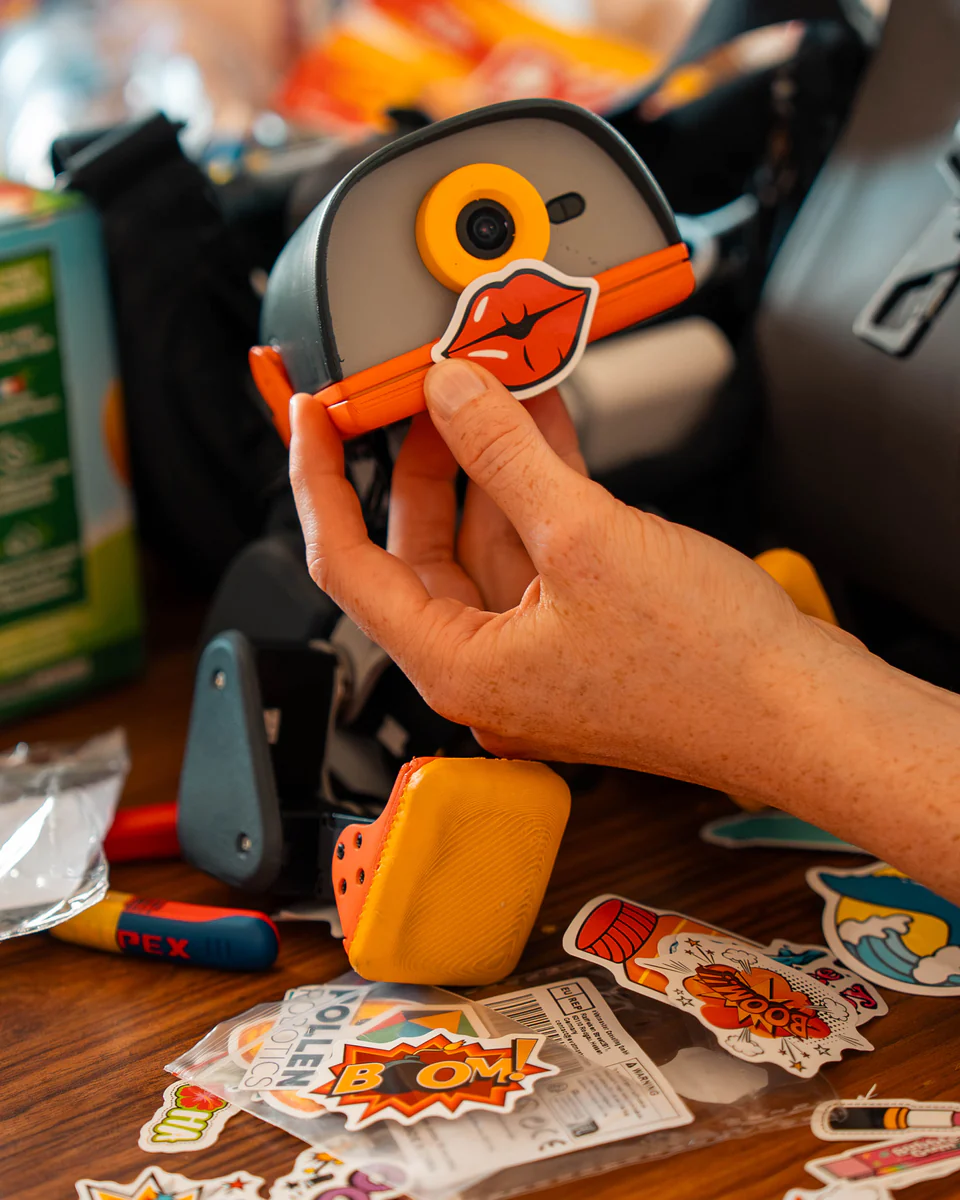 Four colourways and a per-robot generated voice make each duck its own character. Photo: Pollen Robotics / Hugging Face.
There is a clear strategic parallel the company draws itself. Hugging Face became central to AI by being the open hub for language models, and Pollen says it wants physical behaviors to become as easy to share as models: the same democratize-through-openness strategy, aimed at robotics. The theory is that if enough people can cheaply train small robots and share the behaviors they create, a community-driven ecosystem forms the way it did around open models.
 The Pollen Robotics team, who have built open robots from Bordeaux since 2016. Photo: Pollen Robotics / Hugging Face.
The context has only intensified since launch. In September 2026, Nvidia agreed to acquire Hugging Face for about $12.9 billion — a deal expected to close in the first half of 2027 if regulators approve, and one that could put serious weight behind this robotics push. And at GTC Berlin on October 21, 2026, Nvidia’s Jensen Huang brought four Microducks on stage, trained with help from AI agents running on Nvidia’s new RTX Spark PCs — a sign that the little duck has become a public face for affordable, trainable physical AI well beyond Pollen’s own marketing. With preorders near 20,000 by late October, by Delangue’s count, it has already done something notable: it made a walking, learning robot feel like something an ordinary developer could own.
The one thing to take away
Strip away the colorways and the waddle and Microduck is making a specific, unusual argument: that the valuable thing to put in a developer’s hands is not a finished robot but the loop that teaches one. Almost everything it can do is a learned policy, and the recipe for learning — the simulator, the reward functions, the sim-to-real tricks — ships in the open at no cost, and you can try the results in a browser before you spend a cent. That is the real product. The duck is the friendly, fall-over-and-get-back-up body wrapped around it.
That framing is also the honest buyer’s guide. If teaching a robot to walk and sharing what you taught it sounds like a good use of an afternoon, Microduck at $399 is close to unmatched. If you wanted something that works for you out of the box, this duck — like every small robot at this price — is not it. Know which one you are, and the decision makes itself.
Common questions
How much does Microduck cost?
$399, before tax and shipping.
Who makes Microduck?
Pollen Robotics, the Bordeaux-based robotics team owned by Hugging Face, the open-source AI platform. Hugging Face acquired Pollen in April 2025.
When does it ship?
Preorders opened August 27, 2026, with deliveries targeted before Christmas 2026. Pollen now quotes 4–6 months for new orders. Early availability was North America, Europe, and the UK.
Is Microduck open source?
The software is — under the Apache 2.0 license, on GitHub. The hardware is not; Pollen has asked people not to call it “open-source hardware,” and the mechanical and electronic design files are closed.
Do I need to know how to code to use it?
To get the most out of it, yes — the value is in training new behaviors, which means working with the SDK and simulation. But it ships with 7 trained moves and a game controller that work out of the box, and the browser simulator lets anyone try the trained behaviors before buying, at no cost.
What can Microduck do?
Out of the box: walk, crouch, sit, pick up small objects with its beak, recover from falls and pushes, and (with the Accessory pack’s rollers) roller-skate. Beyond that, you train it to do new things with reinforcement learning.
How is it different from Reachy Mini?
Reachy Mini is a stationary desktop robot built for interaction — it stays put and talks. Microduck is mobile and built for action — it walks through the world and communicates in chirps, not words.
How long does the battery last?
Roughly one hour of active use. It is a platform for training and play sessions, not continuous operation.
Can I try it without buying one?
Yes. The Microduck simulator runs in a browser on Hugging Face, and the full software stack is on GitHub, both at no cost.
Sources
- Pollen Robotics, Meet Microduck (27 August 2026) pollen-robotics.com
- Pollen Robotics, Microduck product page pollen-robotics.com
- Pollen Robotics, Microduck press kit pollen-robotics.com
- GitHub, pollen-robotics/microduck github.com
- GitHub, pollen-robotics/microduck_rl (training environments) github.com
- Hugging Face, Microduck Sandbox (the browser simulator) huggingface.co
- NVIDIA, GTC Berlin 2026 keynote: live updates (21 October 2026) blogs.nvidia.com
- NVIDIA, NVIDIA to Acquire Hugging Face (3 September 2026) blogs.nvidia.com
- Axios, Hugging Face debuts "Microduck," a $399 robot (27 August 2026) axios.com
- The Register, Hugging Face offers $399 robot duck to help you quack the AI code (27 August 2026) theregister.com
- MarkTechPost, Hugging Face Unveils Microduck: A $399 Open-Source 25 cm Biped You Train with Reinforcement Learning (28 August 2026) marktechpost.com
- Petoi, Bittle robot dog (store page) petoi.com
- Unitree, Go2 (product page) unitree.com
- Unitree, G1 humanoid (product page) unitree.com